Are you considering teaching English to children?
It’s an extremely rewarding career. You get the pleasure of helping shape young minds and being instrumental in building extremely useful language skills. It’s a challenging task, and English teachers must possess certain skills to be effective at the job.
One of the best ways to obtain the skills you need to teach children is to become certified. Teaching English as a Foreign Language, better known as TEFL, is a professional credential that qualifies you to teach English to non-native speakers.
According to TEFL Org, as you prepare for a career teaching English TEFL certification is a crucial first step for anyone preparing for a career in English teaching. This credential equips educators with essential classroom management tools and specialised, child-friendly methodologies.
Ultimately, becoming certified not only enhances your teaching skills but also qualifies you for higher-paying positions when working with young children.
The ability to speak more than one language is an extremely useful skill, especially for children. The following are just a few of the advantages that can be gained from becoming bilingual at an early age:
Children can learn new languages faster and more naturally than adults because their brains are highly flexible and adaptable.
Studies have shown that the ability to speak more than one language increases memory. Speaking two languages allows children to remember and connect concepts across languages. This helps students when they are involved with activities that require memorisation.
While learning a new language, children are exposed to the customs and values of different societies, which encourages cultural awareness. It also instils in them the ability to see things from the point of view of others.
Learning to speak a second language as a child has several health benefits. It can improve brain function, protect long term cognitive health and build mental flexibility over time.
Research has shown that bilingual children are better able to block out distractions and pay attention longer. It has also been shown that knowing two languages produces better readers. Bilingual students score higher on assessments and adapt to different learning environments more quickly.
Many companies look for workers who speak more than one language, giving students a better chance at employment and improved income potential when they enter the workforce.
To be a successful English teacher to children there are several skills that are needed.
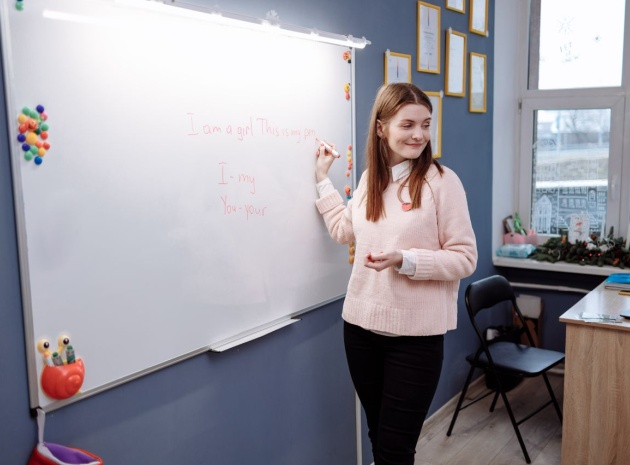
When acquiring a new language, children learn by copying what they hear. They need clear, accurate guidance to help them succeed. Fluency and correct grammar is vital when teaching English.
THE TEFL Org says that “having a comprehensive grammar book at your side is a must whether your focus is on improving your English grammar or going on to teach it”.
There are many ways that fluent teachers can use that skill to help students succeed.
● Scaffolding and simplification: A strong language fluency is needed to explain complex concepts in simple terms. A fluent teacher can rephrase, use analogies, or adjust their speech. When a teacher understands English well, they can break difficult concepts into small, easy steps that children can understand.
● Modelling: Children naturally copy their teacher’s pronunciation, intonation, sentence structure, and vocabulary. They will also adopt errors in their teacher’s speech as their own, making them harder to correct later.
● A Rich Vocabulary: Young children are at a critical period for vocabulary acquisition. A teacher who has strong language skills uses a rich and varied vocabulary that increases and enhances students’ word choices.
Competence in classroom management is important when teaching children because it creates a safe, organised, and positive environment where students can focus on learning. Here are several key reasons it should be a priority:
● Creates a safe environment: Clear rules and consistent expectations help children feel secure and know what is expected of them.
● Maximises learning time: Good classroom management reduces disruptions and gives teachers more time to teach and students more time to learn.
● Builds positive relationships: When teachers are fair, patient, and consistent, students are more likely to trust and respect them.
● Encourages good behaviour: Children learn appropriate ways to interact, solve problems, and take responsibility for their actions.
● Supports different learning needs: Effective management helps teachers organise activities and provide individual attention to students who need extra support.
● Promotes independence: Clear routines allow children to know what to do without always waiting for the teacher’s direction.
● Reduces stress: A well-managed classroom is less chaotic, which benefits both the teacher and the students.
● Helps children develop life skills: Following directions, cooperating with others, managing emotions, and respecting boundaries are skills children can use beyond the classroom.
It’s very important that teachers of young children have confidence because it directly shapes children’s emotional security. A confident teacher models resilient behaviour and creates a stable, safe environment for learning.
● It creates a sense of safety. Young children thrive in a calm atmosphere. A confident teacher signals “this is a safe, structured place, and someone capable is in charge”, which helps children relax, take appropriate risks, and succeed without feeling anxious.
● It affects classroom management. Confidence allows a teacher to set boundaries calmly and consistently. Kids test limits – a hesitant response can encourage even more testing, while a steady, sure one settles things faster.
● Confidence supports learning. A teacher’s confidence in the material being taught and in his/her teaching ability can be very evident – if a teacher hesitates or seems unsure whether a lesson is effective children will notice and engage less in the classroom.
● Confidence is contagious. A calm, confident adult will produce calmer, more confident children, capable of learning more easily.
Having the ability to make learning fun is important for a teacher of young children because children learn best when they are actively engaged and enjoy what they are doing. Some important reasons include:
● Increases engagement: Fun activities hold children’s interest and encourage them to participate more actively.
● Supports different learning styles: Games, art, music, movement, and hands-on activities allow children with different strengths to participate successfully.
● Encourages curiosity: When learning is enjoyable, children are more likely to ask questions and want to discover new things.
● Improves memory: Children are more likely to remember information when they learn it through games, songs, stories, movement, and hands-on activities.
● Builds confidence: Fun activities give children opportunities to attempt new things without being afraid of failing.
● Builds relationships: Sharing fun activities helps teachers create positive, trusting relationships with their students.
Teaching English to children is both a challenging and rewarding career that can have a lasting impact on a child’s life. According to The TEFL Org, effective teachers need more than a strong command of English; they also need confidence, classroom management skills, patience, creativity, and the ability to make learning fun and meaningful.
By creating a safe and engaging classroom, teachers can help children develop not only valuable language skills but also confidence, curiosity, cultural awareness, and a love of learning. With the right training, skills, and dedication, an English teacher can do much more than teach a language – they can open doors to new opportunities and help children build a stronger future.

Abacus – nursery management software
Ace-Owner

 follow us @TeachEarlyYrs